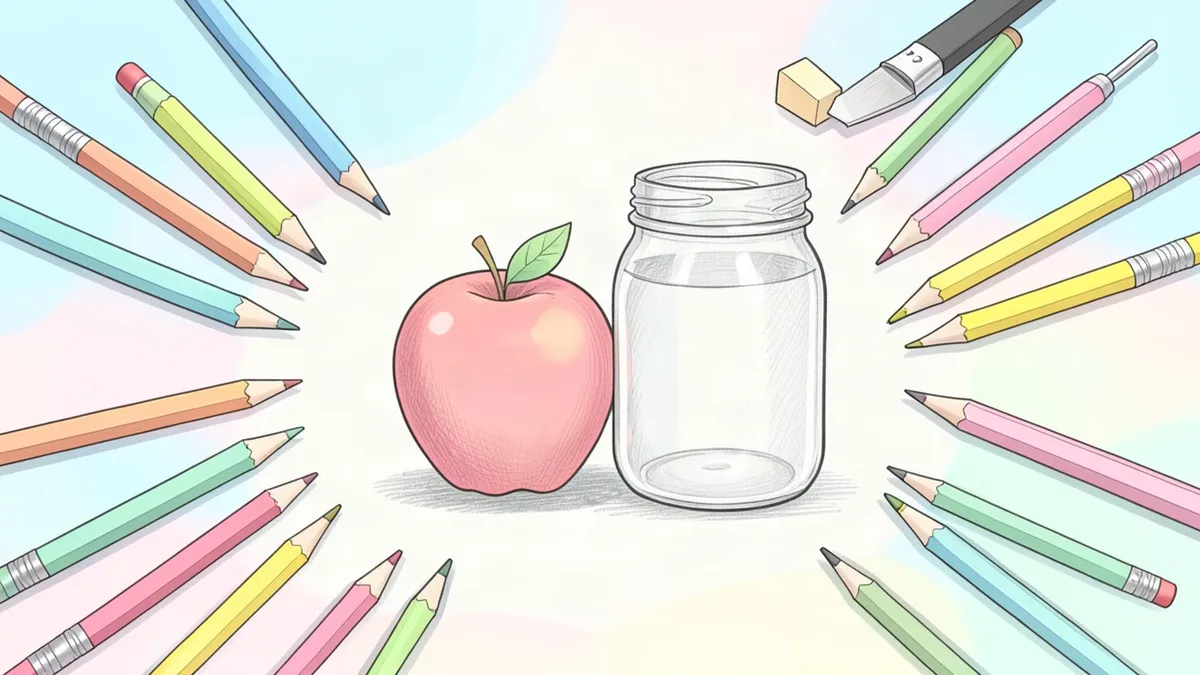
A pencil can only do one thing: make a mark lighter or darker. That limit is why pencil drawing ideas should be chosen for their light and shadow, not their color. The 60 subjects here all look good in black and white, and each section pushes a different skill.
You need one ordinary pencil to begin. A softer, darker one helps later.
- An egg on a white plate with its soft cast shadow
- A sphere shaded in five steps from highlight to core shadow
- A white mug standing against a dark background
- A folded napkin with three crisp creases
- A single pear lit from a window on the left
- A stack of three sugar cubes
- A paper cup lying on its side with the inside visible
- A candle and the gradient of glow around its flame
- A ribbon curling so that both sides show
- A plain cardboard box with one flap open
- A garlic bulb with its papery skin
- A smooth stone with one thin crack
Texture studies
- The weave of a wicker basket
- A patch of cat fur built from short overlapping strokes
- Tree bark with deep vertical furrows
- A rusty hinge on an old door
- A feather with a few barbs pulled apart
- A knitted sleeve with every stitch visible
- A pinecone, drawn scale by scale
- A weathered plank with knots and grain
- A glass marble with a twist inside
- A crumpled piece of kitchen foil
- A scallop shell with ridges fanning out
- A worn leather boot with a creased toe
- A full moon behind bare branches
- A zebra's face cropped close
- A white cat on a black sofa, shown only by shadow
- A piano keyboard receding in perspective
- A city at night drawn as lit windows on black
- A crow perched on a snow-covered post
- A chessboard mid-game from a low angle
- A dandelion seed head against a dark doorway
- Shadows from window blinds striping a wall
- A streetlamp lighting a cone of falling snow
- A panda half hidden in bamboo
- An old pocket watch with its back open
- A rose with its outer petals starting to curl
- A dragonfly wing with every cell of the lattice
- A wave curling just before it breaks
- A birch trunk with peeling bark
- A stem of lily of the valley with hanging bells
- A swan with its neck in an S-curve above its reflection
- A pine ridge in fog, drawn as three fading layers
- A cobweb strung with dew
- A leafless oak with a tangle of fine twigs
- A fawn asleep in long grass
- A waterfall drawn by shading only the rocks around it
- A sunflower head with its spiral of seeds
- A realistic eye with a window reflected in it
- A pair of elderly hands resting in a lap
- A still life of a bottle, a lemon and a cloth
- A bicycle wheel with every spoke
- A portrait in profile with the light behind it
- A cathedral doorway with carved arches
- An open book with its pages mid-turn
- A wolf's face with the fur direction mapped first
- A sailing ship inside a bottle
- A violin lying on sheet music
- A rowboat pulled up on a pebble beach
- A bedroom interior in one-point perspective
- Know the grades. H pencils are hard and light. B pencils are soft and dark. HB sits in the middle. A 2B and a 6B cover most drawings.
- Draw a value scale first. Make five boxes and shade them from white paper to your darkest dark. Every drawing should use all five.
- Shade in layers. Build darks with several light passes. Pressing hard dents the paper and leaves a shine.
- Three ways to shade. Hatching uses parallel lines, cross-hatching adds a second set across the first, and blending smooths the marks with a tissue or a paper stump.
- Save your whites. The brightest highlight is bare paper. Plan it and draw around it.
Work down the page in order. Spend a week in each section, one subject a day, and keep every drawing the same small size, about the width of your palm. After five weeks, lay them side by side. The shading in week five will look like it came from a different person.
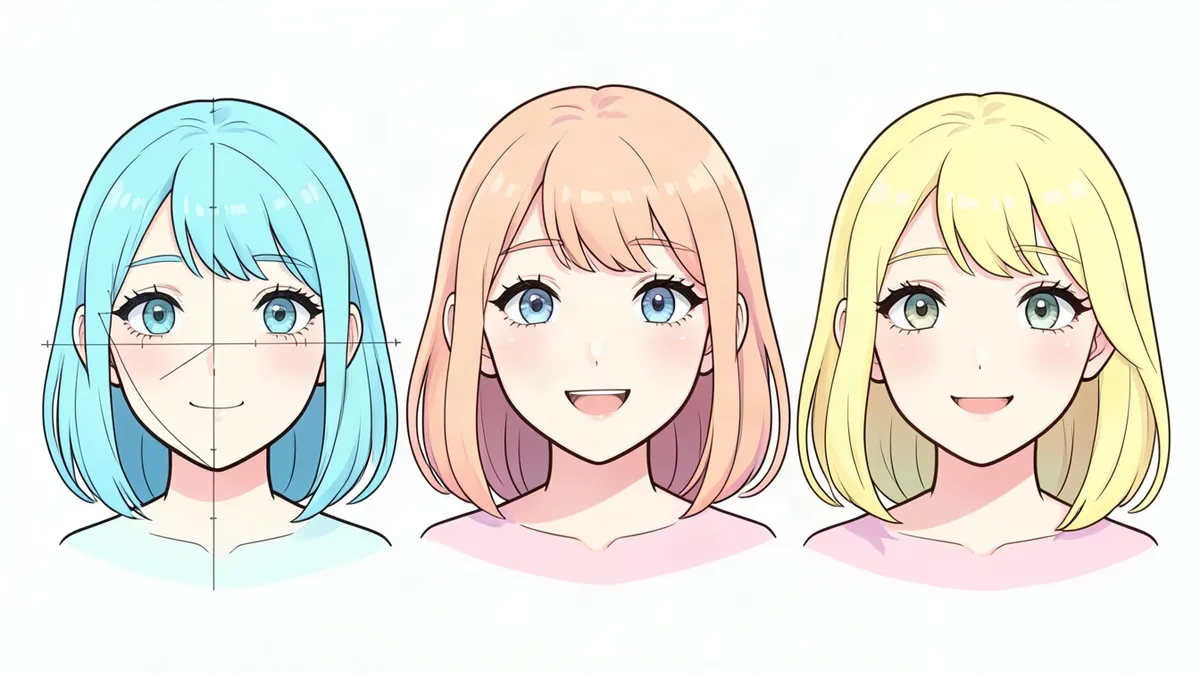
The same light logic applies to faces and figures. If you want a character to practice on, create one in the Character Creator and redraw the portrait in pencil, working out where the light comes from. The guide on how to draw a face covers the proportions.
Related: realistic drawing ideas, sketch ideas and hard things to draw.
Simple white or pale objects under one light: an egg, a mug, a sugar cube, a folded napkin. They have clear shadows and no distracting color.
An HB or 2B is fine for sketching and light shading. Add a 4B or 6B for dark areas. You don't need a full set to start.
Use the full range from white to very dark, keep edges soft where forms turn and sharp where they overlap, and leave highlights as untouched paper.
Rest your hand on a spare sheet of paper, and work from the top left to the bottom right if you're right-handed, or the mirror of that if you're left-handed.