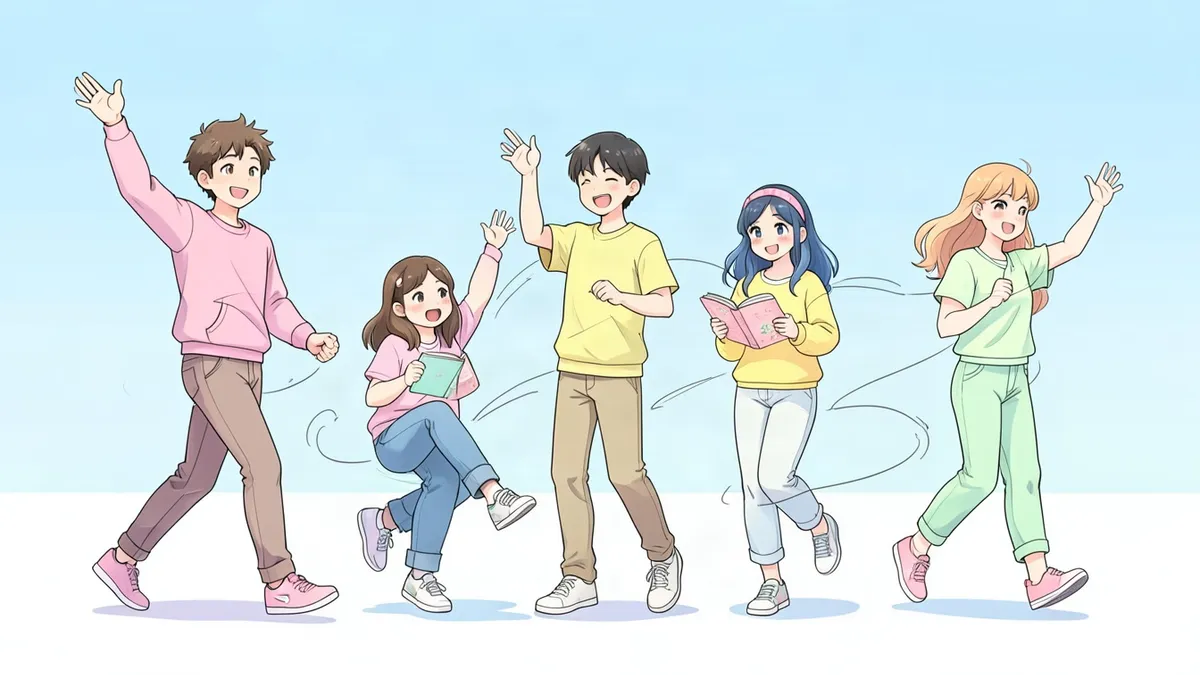
Learning how to draw people is different from learning to draw one person. One figure is a proportion problem. People, plural, are a problem of movement and variety: they lean, sit and walk, they come in different sizes, and they stand at different distances from you.
This guide covers a fast way to capture a pose, an easy shorthand for bodies, how to make each person look different and how to place a group in space.
A gesture drawing catches what the body is doing before what it looks like.
- Draw the line of action. One curved line from the head down through the spine to the foot that carries the weight.
- Add the head as an oval, tilted the way the person tilts it.
- Add the shoulder line and the hip line. In most relaxed poses they tilt in opposite directions.
- Draw the arms and legs as single lines with a dot at each elbow and knee.
- Stop. That's thirty seconds. Do several before you add anything.
- Add volume to the best one: a ribcage, a pelvis and cylinders for the limbs.
For simple, quick people, draw the torso as a bean.
- Draw two overlapping ovals, one for the chest and one for the hips. Together they make a bean shape.
- Bend the bean to show leaning, or pinch one side to show a twist.
- Put a circle on top for the head.
- Add stick arms and legs with joint dots, then thicken them if you like.
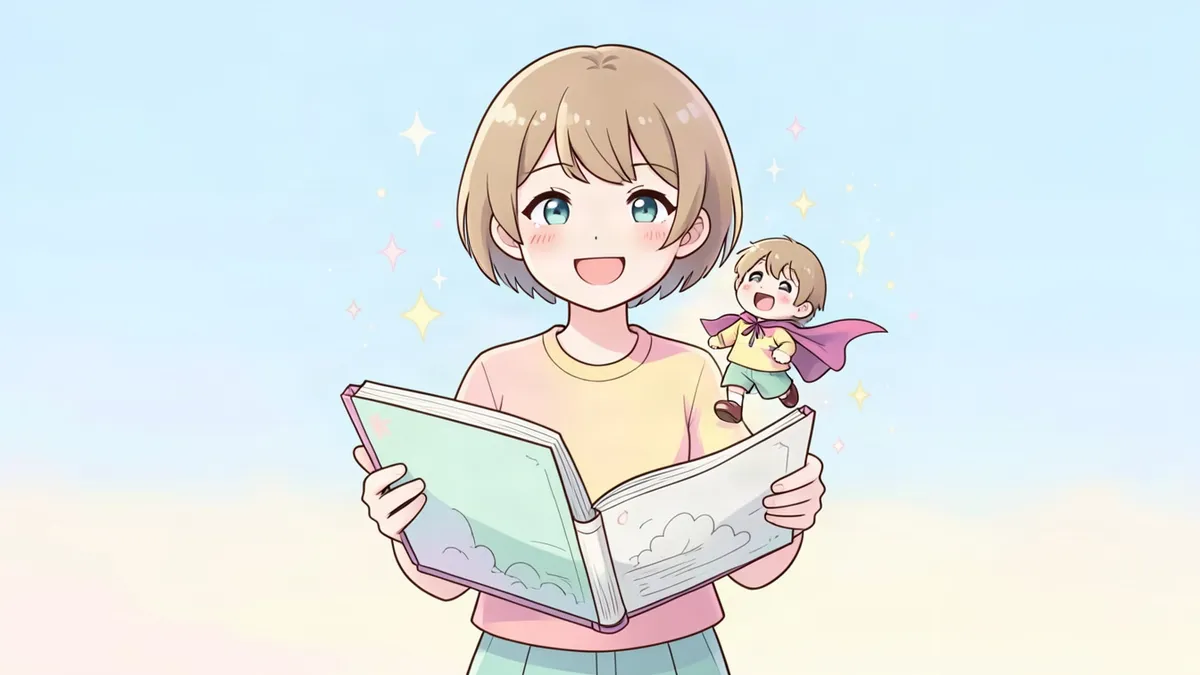
A bent bean reads as a living body even with no detail. For tiny doodle people, make the figure only two or three heads tall and give each one a different hairstyle and one prop.
Beginners often draw one body and copy it. Change these four things:
- Height in heads. Adults are seven to eight heads tall, teenagers six to seven, children four to six and toddlers about four. A child's head is smaller than an adult's in real size, but larger compared with the body.
- Build. Change the width of the shoulders, ribcage and hips separately. Don't just inflate the outline.
- Posture. A straight spine, a slouch and a forward lean belong to three different people.
- Silhouette. Hair, a coat, a bag or a hat changes the outer shape more than any face detail does.
Perspective is what puts people on the same ground.
- Draw the horizon line. It sits at your eye level.
- Use the horizon rule. If you're standing on flat ground, the horizon passes through the heads of standing adults close to your height, however far away they are. Near people are large with their feet low on the page. Far people are small with their feet higher up.
- Adjust for your viewpoint. If you're sitting, the horizon may cross the nearest person at the chest. It then crosses every standing person of similar height at the chest.
- Overlap the figures. Let near people cover parts of far ones.
- Cluster them. Real crowds form groups of two or three with gaps between. An evenly spaced row looks staged.
- Fade the detail. Give the nearest people faces and folds. Draw the farthest as simple shapes.
- Work from life or your own photos. Invented poses repeat your habits.
- Check balance. A standing figure's weight falls over the supporting foot.
- Let clothes hang from points. Fabric pulls from the shoulders, elbows, waist and knees.
- Draw what you see. A foreshortened arm really is that short.
- Clones. Vary height, build and posture before you add faces.
- Floating people. Place the feet using the horizon rule and add a small shadow under each person.
- Stiff outlines. Begin with the line of action, not the contour.
- Heads at random heights in a crowd. On flat ground, heads of similar people line up near one level.
- Too much detail far away. Simplify with distance.
- Ten gestures. Sketch ten people in thirty seconds each, in a cafe, in a park or from a paused video.
- Lineup of five. Draw a child, a teenager, two adults of different builds and an older person as plain silhouettes.
- Crowd of twelve. Draw a horizon line and place twelve standing figures at different distances using the horizon rule.
- Doodle people. Fill a row with twelve tiny bean people, two heads tall, each with different hair and one prop.
Stories need more than one person. Once you can draw varied people, try designing a small cast whose silhouettes are easy to tell apart. The guide to character silhouettes explains the test designers use. To get quick character concepts for a lineup, roll a few in the Random Character Generator.
Related: how to draw a person, how to draw a body and people drawing ideas for subjects.
Start with thirty-second gesture drawings: a line of action, a head, shoulder and hip lines and stick limbs. Add simple volumes once the pose reads.
Use a bean for the torso, a circle for the head and sticks for the limbs. Bend the bean to show the pose. This works at any size, including tiny doodle figures.
Draw a horizon line at your eye level and hang the heads of standing figures on or near it. Make near people larger with lower feet, overlap them and simplify the ones in the distance.
Observe real people, check proportions with head-heights, make sure each figure is balanced over its feet and let the clothing folds come from the shoulders, elbows, waist and knees.