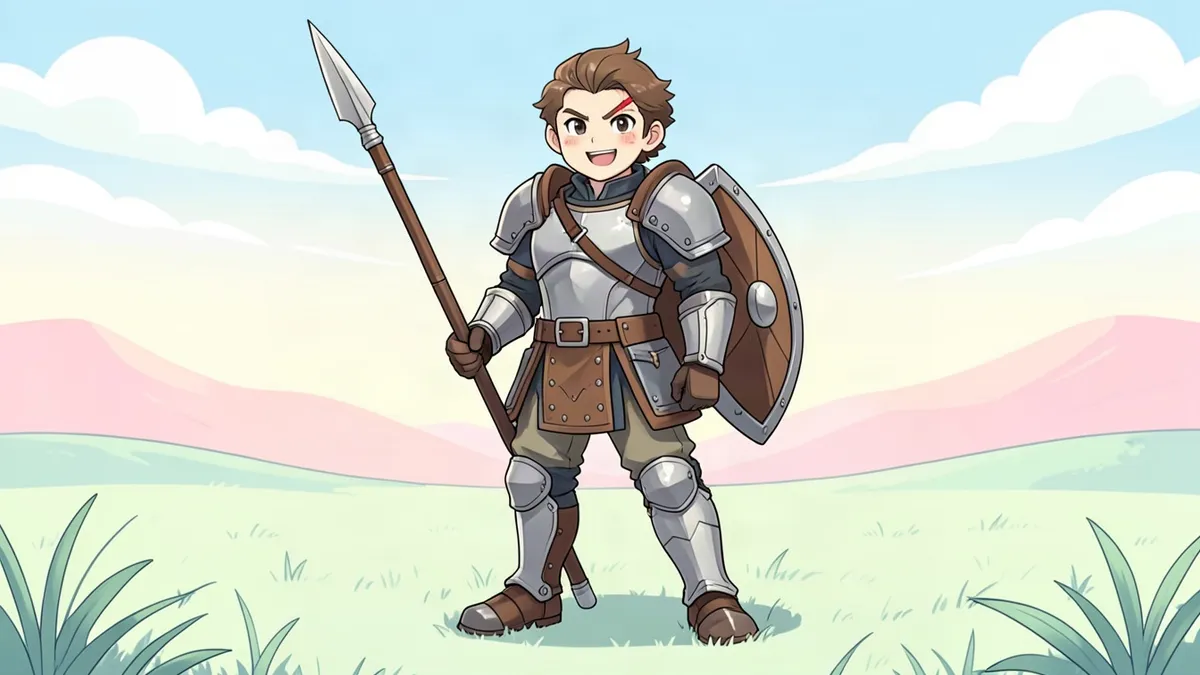
Warrior OCs are original characters defined by fighting: knights, mercenaries, guards, duelists, arena champions. The good ones look like they've trained with what they carry and have a reason to carry it. This guide covers weapon, armor, color and motive, then gives you 12 warriors to adapt.
Choose the weapon before the outfit
The weapon sets the build, the stance and the armor.
- Sword and shield: a balanced build, heavier armor on the shield arm, a side-on stance
- Spear or polearm: long reach, lighter armor, a lean frame and a great outline
- Bow: strong back and shoulders, a bracer on the bow arm, very little metal
- Two-handed sword, axe or hammer: broad shoulders, a wide stance, armor up top
- Paired short blades: fast and light, close-fitting clothes, nothing that snags
- Unarmed: wraps on the hands and shins, loose trousers, calloused knuckles
- Staff: a traveler's weapon that doubles as a walking stick
Armor that makes sense
- Cover what matters first. Head, chest and forearms. Bare stomachs and decorative gaps make a fighter look inexperienced.
- Asymmetry is realistic. One large shoulder guard on the leading side looks practical and makes the outline more interesting.
- Layer materials. Padded cloth, then mail, then plates, held together with leather straps.
- Show repairs. Mismatched rivets, a patched sleeve, a strap that's newer than the rest.
- Keep the face readable. An open helmet, or one carried under the arm or hung from the belt.
Borrow your palette from heraldry
Coats of arms keep to a few bold colors set against a metal, gold or silver, so a shield reads from far away. Borrow that: two colors and one metal.
- Crimson and white with steel
- Forest green and gold
- Black and sky blue with silver
- Plum and cream with bronze
Put the colors on the cloth parts: tabard, sash, cloak, shield face. A mercenary can break the rule on purpose with faded pieces from three past employers.
Signature details
- A small scar with a story, like a nick through one eyebrow
- A token tied to the weapon: a ribbon, a charm, a child's bracelet
- A weapon with a name, and a reason for the name
- A habit before every fight, such as retying their hair or humming the same tune
Why do they fight?
Motive separates one sword-carrier from another.
- Paid: mercenary, caravan guard
- Sworn: knight, bodyguard, oath-keeper
- Born into it: a clan or family trade
- Forced: conscript, arena fighter
- Protecting: one person, one village, one road
- Finished: retired, until something pulls them back
Then ask what fighting has cost them. Time, a friendship, a home, a good night's sleep. Our tragic backstory examples show how to write that cost without overdoing it.
12 warrior OCs to adapt
- A shield-bearer who has never carried a weapon and wins by outlasting everyone.
- A retired arena champion who teaches children's fencing and still gets recognized at the market.
- A knight whose armor is a size too big because it was her mother's.
- A mercenary who keeps strict working hours and stops fighting at five.
- A spear fisher drafted into the militia who still fights as if he's wading in a river.
- A royal guard who has stood at the same door for 20 years and has never been told what's behind it.
- A duelist who is undefeated because she talks every opponent out of the duel.
- A blacksmith who had to pick up the sword he was making, and never got to finish the hilt.
- A desert caravan guard who navigates by the stars and fights with a staff.
- A squire who is better than his knight and is working hard to hide it.
- An old general who hasn't seen a battle in 30 years and plays board games against her former rival by letter.
- A warrior monk who vowed to do no harm and has become very good at disarming people.
Cliches and how to twist them
- The silent lone swordsman. Twist: he's chatty and narrates his own fights, and he's still serious about training.
- Revenge for a burned village. Twist: the village is fine. He left after an argument and is too proud to go back.
- Armor that's all decoration. Twist: practical armor with one vain piece they refuse to give up, like a ridiculous plume.
- The chosen one with a destined blade. Twist: the blade chose someone else, and they're only delivering it.
Prompts you can paste
Try these in the Character Creator:
A woman knight in her forties, short gray-streaked hair, steel plate armor slightly too large with a crimson and white tabard, large shield on her left arm, helmet under her right arm, calm tired smile, castle courtyard, semi-realistic fantasy illustration
A young desert caravan guard, brown skin, long braid, loose sand-colored robes with a turquoise sash, leather bracers, wooden staff across his shoulders, night sky full of stars, anime style
Need a name? The free Fantasy Name Generator can help, and our list of fantasy character names has a section for knights. To check that the weapon and armor read clearly, run the black-fill test in the character design silhouette guide.
FAQ
What are warrior OCs?
Warrior OCs are original characters whose role is fighting, such as knights, mercenaries, guards or duelists, each with their own gear, style and reason to fight.
How do I design armor for a warrior OC?
Start from the weapon and fighting style, protect the head, chest and forearms first, layer cloth and metal, and add repairs so the armor looks used.
What weapon should my warrior OC use?
Choose one that fits their build and background. A fisher might use a spear, a traveler a staff. The weapon should explain something about their life.
How do I keep a warrior OC from being generic?
Give them a clear reason to fight, something fighting has cost them, and one detail that clashes with the tough image.